Vai al contenuto
232.514 profili in classifica

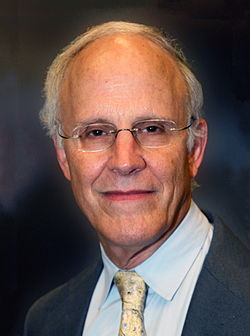
David Gross

Stati Uniti · Sulla mappa · Scienziati · Nascita: 1941 · 85 anni

David Jonathan Gross (Washington, 19 febbraio 1941) è un fisico statunitense. È vincitore del Premio Nobel per la fisica del 2004, insieme a Hugh David Politzer e Frank Wilczek, per la scoperta della libertà asintotica nella cromodinamica quantistica, che ha permesso di completare il quadro del modello standard.

Testo tratto da Wikipedia, CC BY-SA 4.0

David Gross: circa 330 letture al giorno, in 73 lingue.

Un giorno tipico, 30 giorni fino al giorno 20 novembre 2026

Il giorno centrale tra quelli contati, quindi una settimana di notizie non può spostarlo. La linea sotto mostra gli ultimi 400 giorni, un punto al giorno.

Qualcosa non va?
Confronto Rivendica

Una vita in date

2015“Physics is always a gamble; it is a game of exploration. That’s the fun of it. We never know for sure what will happen.”Con parole sue"Physics is always a gamble", an interview with David Gross by Shubashree Desikan, The Hindu (2015)

2013“Remarkably, the building of the Standard Model - the theory of how particles and forces interact - was the success of the conservatives.”Con parole sue"Waiting for the Revolution", an interview of David Gross by Peter Byrne, Quanta Magazine (2013)

2004“... From the age of 13, I was attracted to physics and mathematics. My interest in these subjects derived mostly from popular science books that I read avidly.”Con parole sue"David J. Gross - Biographical", Nobel Prize in Physics, nobelprize.org (2004)

“The universe has been expanding since the big bang, thus early on it was hot and dense.”Con parole sue"The Discovery of Asymptotic Freedom and the Emergence of QCD", Nobel Lecture, p. 79, nobelprize.org (2004)

Premio Nobel per la fisicaPremio2000Premio HarveyPremio1987Premio MacArthurPremio1941Nascita19 febbraio 1941

Intorno a David

Media e musica

Foto 1

Citazioni 3

,
David Gross
,
3 dichiarazioni, dalla più recente
  1. Traditionally, fundamental theories of nature have had a tendency to break down at short distances.

    "Chapter 7. Asymptotic Freedom, Confinement and QCD" in History of original ideas and basic discoveries in particle physics, edited by, Parole sue

  2. Why is space-time doomed? There are many reasons, among which: In string theory we can change the dimension of space-time by changing the strength of the string force.

    "Einstein and the Search for Unification", p. 11, in The legacy of Albert Einstein: a collection of essays in celebration of the year of, Parole sue

  3. We now know that string theory and quantum field theory can often be different ways of looking at exactly the same phenomena.

    (quote at 1:53:25 of 2:13:05 in video), Parole sue

Wikiquote, CC BY-SA 4.0

Premi

Premio Nobel per la fisica2004
Premio Harvey2000
Premio MacArthur1987

Su questa persona

Paese
Stati Uniti
Categoria
Scienziati
Tipo
Scienza
Stato
In vita
Date
Nascita: 1941 · 85 anni

Presenza online